



FireSmart New Brunswick is sharing simple steps that can help protect homes and communities from wildfires.
Provincial FireSmart Coordinator Travis Judd said the program focuses on practical actions that reduce the chance of wildfire damage.
He said most of the risk starts in the ‘home‑ignition zone‘, the area within 30 metres of a house.
“Small changes around a property can make a major difference,” Judd said.
“Ninety per cent of homes ignite from embers, not flames, and those embers can travel several kilometres ahead of a wildfire,” Judd said.
Protecting the home‑ignition zone
FireSmart divides a property into three zones. The first zone covers the first metre and a half around a home, which Judd described as the most important area to keep clear of leaves, wood piles and anything that can burn.
“The goal is to remove anything that could catch if an ember lands there,” Judd said.
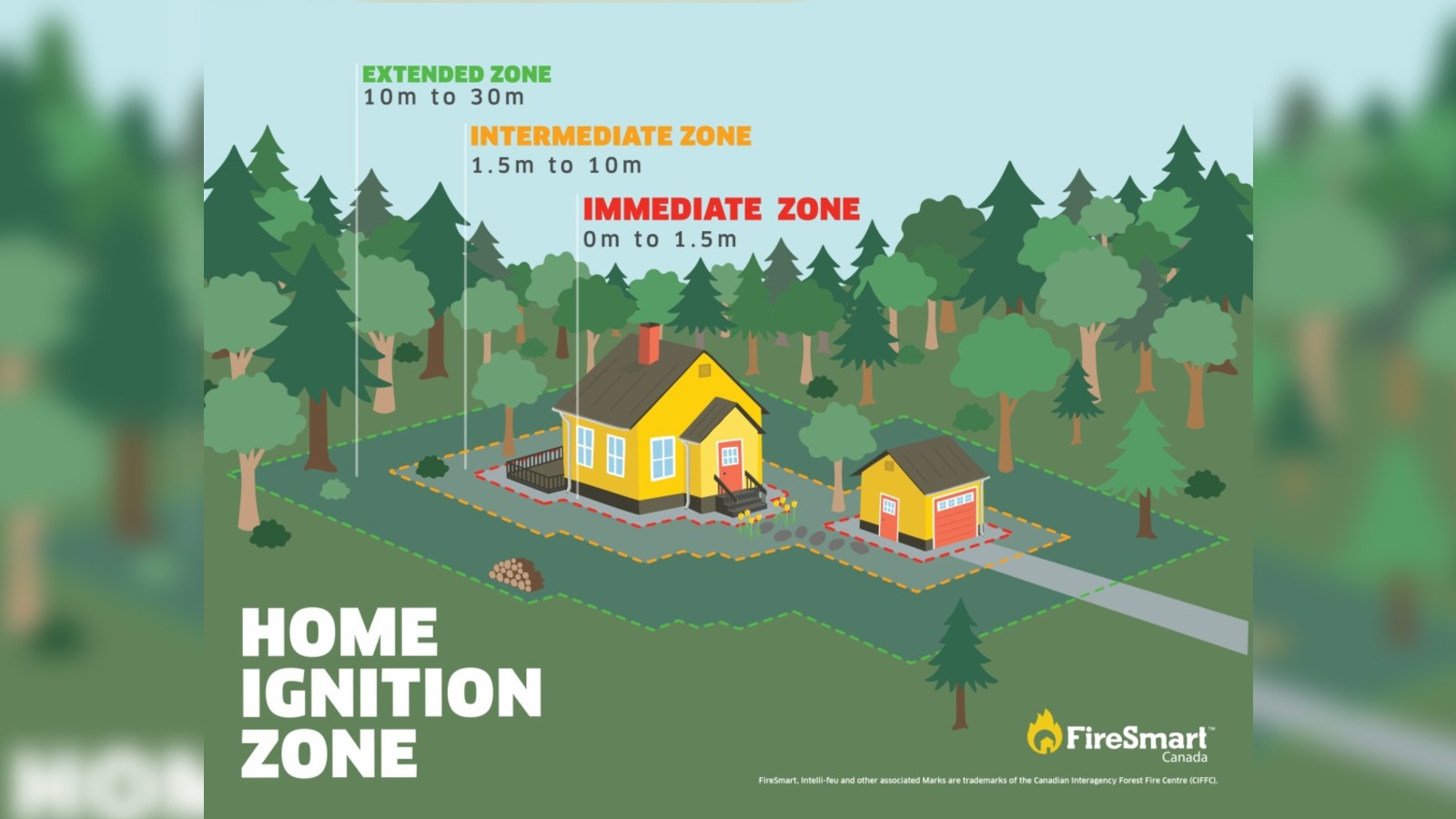
The second zone includes the yard, where residents are encouraged to trim trees, space out plants, and keep grass short.
The third zone extends up to 30 metres and beyond, where thinning trees and removing dead branches can help slow a fire before it reaches a structure.
Residents can assess their own property using the FireSmart mobile app.
The app provides a checklist covering roofs, gutters, vegetation, decks and fuel storage.
Community planning and daily burn notices
Judd said communities also play a key role in reducing wildfire risk.
FireSmart New Brunswick supports the Community Wildfire Resiliency Program, which helps municipalities develop local plans focused on risk assessment, risk reduction, emergency planning and public education.
Fifty communities are currently involved, with 24 plans already in place.
Judd said the province’s daily burn notice is another important tool for preventing human‑caused wildfires.
The notice is posted on the New Brunswick FireWatch dashboard and is updated each day at 2 p.m. during the wildfire period.
“The burn notice tells people whether it’s safe to have an outdoor fire,” Judd said.
There are three burn conditions displayed on the dashboard. Green means burning is permitted under normal rules.
Yellow means burning is allowed only overnight, from 8 p.m. to 8 a.m., because daytime conditions are too dry. Red means no outdoor burning is allowed.
“Green means go, yellow means wait for night and red means no burning at all,” Judd said.
Families are also encouraged to prepare emergency plans and grab‑and‑go kits with water, medication, chargers, documents and basic supplies.
“Some fires can move up to 22 kilometres an hour, so it’s important to be ready to leave quickly if conditions change,” Judd said.
More information is available at FireSmart NB, and the provincial burn line can be reached at 1‑866‑458‑8080.