



I like to observe the sky at least once every day that I can, even if it is just for a few minutes. Often that entails observing the Sun through filtered telescopes and sketching the sunspots and prominences in my logbook. At night if I don’t feel like taking out a telescope I grab binoculars to perhaps see a comet or Mercury, or more often I tour the brighter star clusters. The mid-autumn constellations are home to many star clusters within easy reach of binoculars.
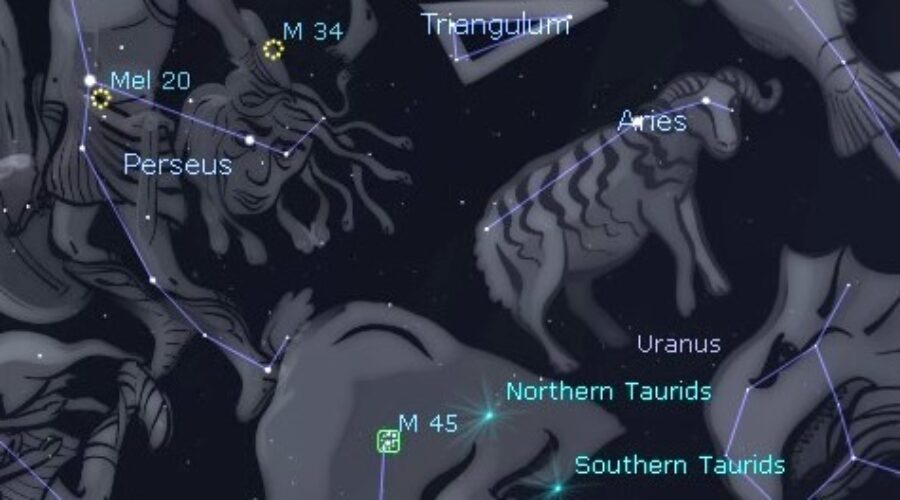
I usually start with the best open cluster, the Pleiades (M45) in the shoulder of Taurus the Bull, and focus the binos on its stars. The large V-shaped Hyades cluster, catalogued as Melotte 25, is nearby forming the face of the bull. It is anchored by orange Aldebaran at one corner, but that star is not really part of the cluster because it is less than half the distance to the others. The brightest star in nearby Perseus, Mirfak, is part of a group of stars called Melotte 20 that resembles a miniature version of the constellation Draco in binoculars. Perseus also holds the star cluster M34, which appears as a fuzzy patch in binos due to its distance. Between Perseus and Cassiopeia is a scenic Double Cluster (Melotte 13/14). Follow a string of stars from there to a large, dimmer cluster called Stock 2 or the Strongman Cluster.
This Week in the Solar System
Saturday’s sunrise in Moncton is at 7:08 and sunset will occur at 4:56; 7:11 and 5:03 in Saint John, giving 9 hours 52 minutes of daylight; and 7:16 and 5:08 in Saint Stephen. Next Saturday the Sun will rise in Moncton at 7:18 and set at 4:48; 7:21 and 4:55 in Saint John, giving 9 hours, 34 minutes of daylight; and 7:26 and 5:00 in Saint Stephen.
The slim crescent Moon makes a close grouping with Venus and Spica this Saturday morning and it is new on Monday. Mars really puts the moves on Jupiter this week, decreasing their separation by more than half as both edge toward Regulus in Leo. Venus is just to the right of Spica in Virgo this weekend, rising before 5 am, and by next weekend it will be above Spica. Late in the week Mercury rises before 6 about two binocular widths to the lower left of Venus. Saturn is at its best for telescope observing in the mid-evening. The North Taurid meteor shower peaks this Thursday, adding a few extra shootings stars that morning and Friday.
The Saint John Astronomy Club meets this Saturday at 7 pm. Tune in to the Sunday Night Astronomy Show at 8 pm on the Facebook page or YouTube site of Astronomy by the Bay. The Fredericton Astronomy Club meets in the UNB Forestry-Earth Sciences building on Tuesday at 7 pm.
Questions? Contact Curt Nason at nasonc@nbnet.nb.ca.