




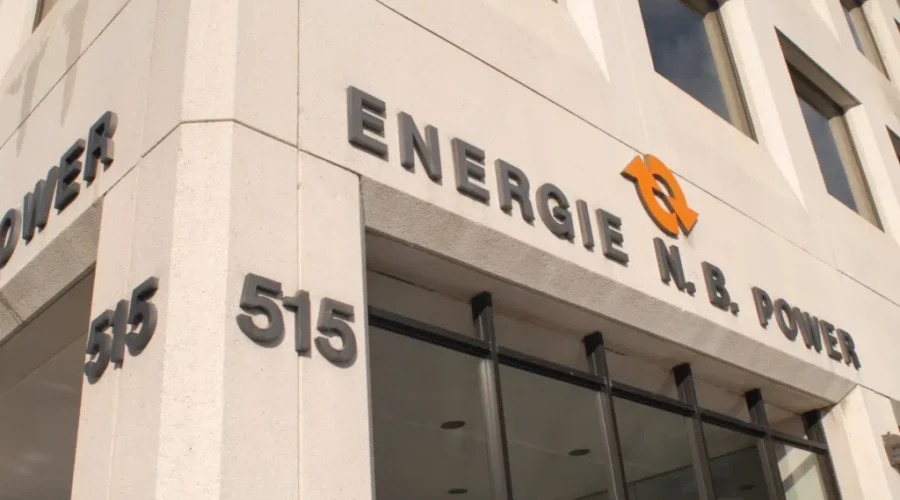
NB Power’s latest 20-year plan says investment in nuclear energy will bring significant savings to rate-payers.
The corporation released its 2026 Integrated Resource plan on Monday.
The plan is NB Power’s roadmap to ensure that it can meet energy demand over the next 20 years.
In a scrum, the utility’s chief commercial officer Brad Coady told reporters the IRP is not making a case for any technology, but the report points out that large-scale nuclear growth will bring the most benefits to New Brunswickers.
“We are not looking at this as if we have a favorite technology or a favorite way to meet New Brunswick’s needs over the next 20 years. We have let the information sort of speak for itself,” he said. “But one of the stories I tell folks is just how different our system is today because of Point Lepreau.”
According to Coady, Point Lepreau’s presence prevented New Brunswick from relying on massive coal-fired generation.
He notes that without nuclear energy, the province would likely have built over 2,000 megawatts of coal capacity, resulting in a much more severe carbon emissions problem today.
Coady added that with the province being mandated to phase out coal generation over the next four years, nuclear remains a key alternative to help fill this gap.
“It’s the best option. When you think about our system and where the carbon comes from, it’s the best replacement for the resources that we currently have that produce carbon in our system,” he said. “If you are going to constrain carbon across the country or in New Brunswick, new nuclear is a major part of how you can do that effectively.”

The previous 2023 plan championed small nuclear reactors (SMRs), but Coady said the 2026 plan is focuses on new nuclear, which could include SMR’s or large nuclear projects.
The report outlines that if Point Lepreau retires in 2041/42 without extending its life, New Brunswick will face a massive capacity and energy deficit.
It adds that replacing it would require building 1,500 to 1,800 megawatts of additional renewable energy and 600 to 700 megawatts of combustion turbines, raising system costs and increasing greenhouse gas emissions over the long term.
The plan calls for refurbishing the nuclear station, claiming that while it will cost the utility $600 million, extending Lepreau’s lifespan will provide an estimated $900 million in annual value to the system, resulting in net savings of $300 million for customers.
Coady acknowledged that reliability issues at Point Lepreau have significantly contributed to NB Power’s debt.
He said Lepreau’s recent performance “is not acceptable.”
This year the plant had two unexpected shutdowns; the most recent happened in early September, which was caused by a leak in non-nuclear equipment that turned out to be radioactive.
RELATED: Point Lepreau shut down since Friday
However, Coady said the generating station remains a critical part of the province’s power system.
“I’d argued that the larger driver of our debt is that when it doesn’t produce the electricity that we depend on it for, we have to turn to more expensive sources, which really shows the benefits that a healthy Lepreau provides energy to all of its customers,” he said.
The plan also suggests that doubling the province’s nuclear footprint by adding 1,500 megawatts of nuclear energy between 2039 and 2045 — including a 500-megawatt regional export partnership — will displace the need for the new wind, solar, and batteries.
The plan includes scenarios aimed at achieving a net-zero electricity grid by 2050, although timelines vary depending on the scenario.
Energy costs rising
With the coal phase-out, the report notes costs per unit of energy are expected to increase by 22 per cent within the next three years, driven by the Belledune Generating Station transition to wood pellets, said Coady.
Major repairs needed to extend the life of the Mataquac Generating Station to 2032, growing electricity demand driven by population growth and increased power use, and the pace of the utility’s transition to net-zero emissions are all contributing to higher costs.
According to the report, those costs could increase the amount of revenue collected from ratepayers by between $2.6 billion and $4.2 billion by 2045-46.
Coady said it’s difficult to determine how those costs would translate into future rate increases, noting that electricity rates are set through a separate process overseen by the New Brunswick Energy and Utilities Board.
He said keeping electricity affordable for ratepayers remains a priority for NB Power, adding that achieving that goal will require a mix of solutions.
“I often describe the power system much like an orchestra, and we need all parts of that orchestra performing in tune, or we’re not going to sound very good,” he said.
He explained there is not “one silver bullet” that we can use to address all of the province’s power needs.
“We need demand response, we need new battery technology, we need more renewables, as well as combustion turbines and nuclear have a role depending on how the system unfolds over the next 20 years,” he said.
The plan is also calling for a 500-megawatt battery storage in the province in the next decade, for big build-outs of wind and solar generation, and an expansion of gas turbine generation.
Editor’s note: An earlier version of this story incorrectly stated that NB Power’s 2026 Integrated Resource Plan would achieve a net-zero electricity grid by 2040 across all proposed scenarios. In fact, the plan’s base “High Load Growth and Net-Zero 2050” scenario does not reach net-zero before 2050, and several no-nuclear scenarios also do not achieve net-zero before 2050. We regret the error.