




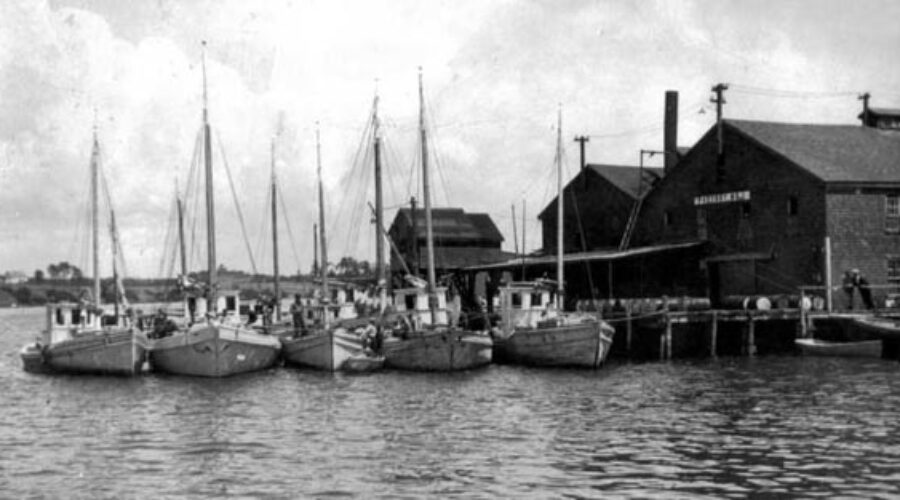

Connor Bros. fleet in Blacks Harbour
Within the first year of the Loyalists arrival to our area, they had already achieved massive industrial output! A 1784 letter from St. Andrews resident states: “although the first of our settlers arrived here in October, we have already sent a number of cargoes of lumber to the West Indies and to several ports in Nova Scotia. As more are now erecting, our exports of lumber will greatly increase.”
By 1803, the Registrar of Probate, Donald MacDonald, placed the number of sawmills in the county at 22, with a total yearly production of 7,700,000 board feet. The fishing industry was also booming by this point, with MacDonald recording that our county had exported some 9,500 quintals (1 quintal equaling 100 kilos) and 3,000 barrels of fish that year alone.
Shipbuilding was also a prosperous industry in Charlotte County at the turn of the 19th century. A total of 47 vessels had been built in the county prior to 1803 – all but 5 of which were built in St. Andrews.
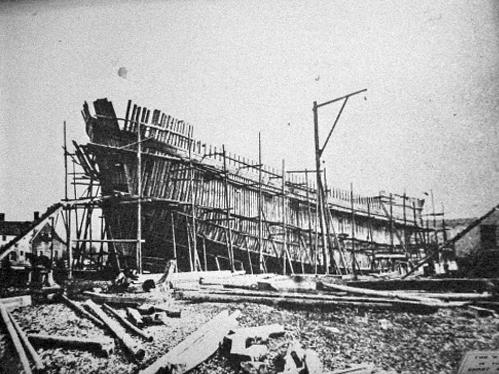
The vessel “The Rocklands” under construction in St. Stephen
Ganong Bros. was founded in St. Stephen in 1783. It’s recognized as Canada’s oldest candy company, still producing products that can be found on store shelves around the world; pioneering Canada’s first lollipops in 1895 and introducing the first heart-shaped chocolate box. Early St. Stephen was also home to the Douglas Axe Manufacturing Company, which was built on the banks of Dennis Stream in 1866 and the St. Croix Soap Manufacturing Company which started operation in 1887.
Meanwhile, what began as a small-scale sardine canning operation using homemade equipment in 1889; Connor Bros. was exporting over 1 million tins of canned sardines from Blacks Harbour by the early 1900’s.
Additionally, St. George was home to the St. George Red Granite Co., established in 1873.
Gradually, however, control of many of these industries would become increasingly concentrated into the hands of a smaller and smaller group of national business owners in the 20th century, leading to the shuttering of many of the smaller mills, fisheries and ship yards.